
The Great Safety Swindle: How Legal Theater Kills More Time Than Actual Disasters
How Milwaukee's response to a deadly arson reveals America's addiction to performative safety measures that consume more human life than they save
You're strapped into your seat on the tarmac, listening to the same script you've heard hundreds of times: "In the unlikely event of a cabin pressure loss, oxygen masks will drop from above your seat..."
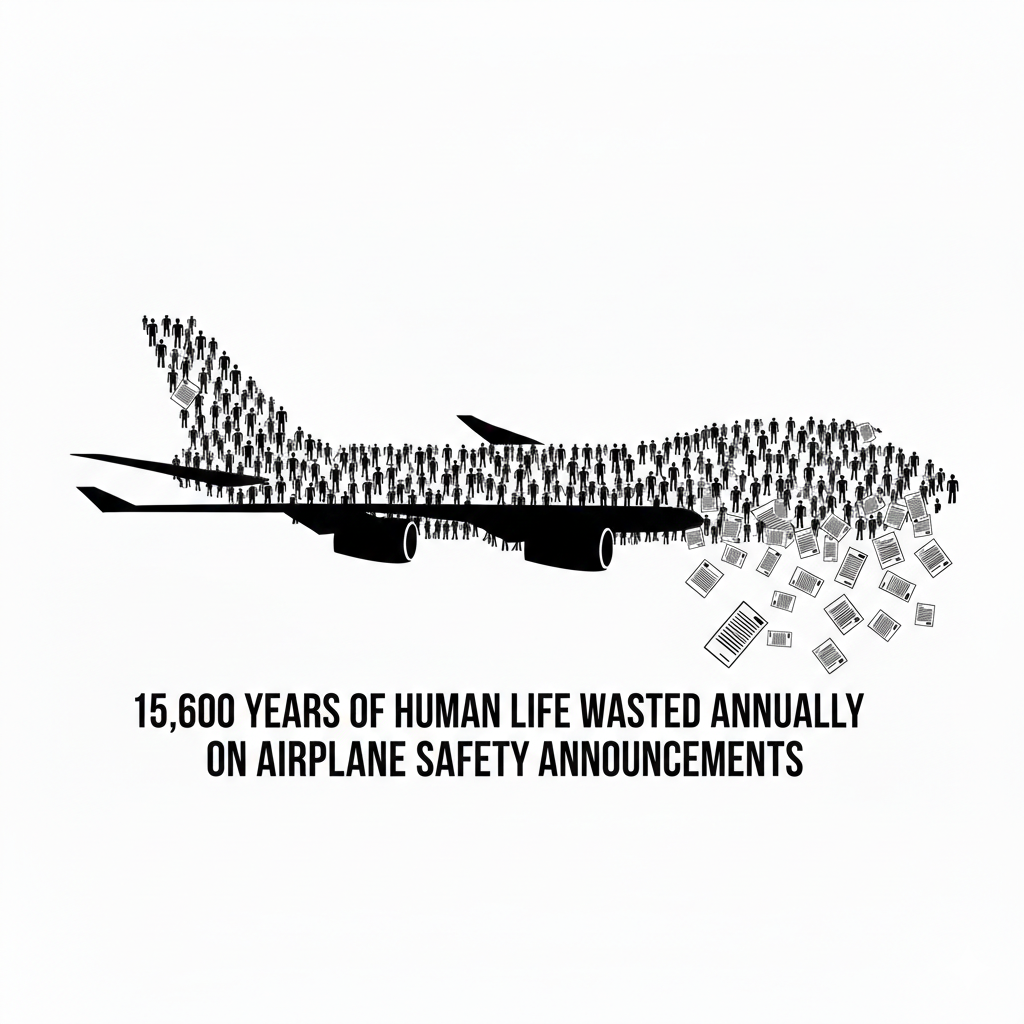
The flight attendant drones on about seatbelts—as if anyone over age five needs instruction on basic buckles. You check your phone, close your eyes, anything to escape the mandatory theater. But here's what you're not thinking about: this five-minute performance, multiplied across America's 45,000 daily flights and 100 passengers per flight, consumes roughly 15,600 years of human life annually.
That's nearly one fully-loaded Boeing 747 worth of human existence—gone, every single year, listening to safety instructions that have never saved a documented life.
And now Milwaukee has found an even more absurd way to burn through human life in the name of "safety."
When Arson Meets Bureaucracy
On May 11, 2025, someone set fire to the hallways of Milwaukee's Highland Court Apartments after what witnesses described as an argument between two people on the third floor. Five people died, hundreds were displaced, and residents jumped from fourth-floor windows to escape the flames.
The building, constructed before 1974, lacked sprinkler systems—a legal exemption that fire officials said COULD have prevented the tragedy had it been eliminated.
But here's the reality: sprinkler systems are designed to suppress accidental fires—kitchen blazes, electrical faults, cigarette accidents. They are not rated to stop a determined arsonist. When someone intentionally sets hallway fires, sprinklers face an impossible task. The system that might save you from a forgotten candle becomes nearly useless against criminal intent.
Milwaukee's response? On November 25, 2025, the Common Council unanimously passed File #250302, requiring landlords to give tenants a piece of paper explaining whether their building has sprinklers.
Five people burned to death because someone set hallway fires after an argument. The city's solution: mandatory paperwork about the lack of sprinklers.
The Media's Convenient Blindness
What's particularly disturbing is how local news coverage obscured the arson angle. WISN's reporting mentioned witnesses hearing "two people arguing on the third floor in a hallway before the fire started" and noted that ATF arson investigators spent twelve hours at the scene, but never clearly stated this was intentional arson following a confrontation.
Why the euphemisms? Why not report clearly that this tragedy resulted from someone's decision to commit arson after an argument? Until we acknowledge that some fires result from criminal behavior rather than faulty wiring or unattended candles, no meaningful solutions can emerge. You can't engineer away human malice with disclosure forms.
The Mathematics of Fake Hope
Milwaukee has approximately 200,000 rental units with roughly 35% annual turnover—about 70,000 disclosure forms annually. Factor in the time for landlords to prepare documents, explain requirements to tenants, collect signatures, and maintain three-year records as mandated, and you're looking at 15-20 years of human life consumed annually for a policy that ignores basic economic realities.
But let's return to first principles: Do we really believe disclosure forms change behavior? Consider the single mother of three children looking for housing in Milwaukee. She finds two options: a 1970s apartment without sprinklers for $800/month in a relatively safe neighborhood, or a modern apartment with full fire suppression for $1,200/month in an area with higher crime rates.
She's not making this choice in an information vacuum. She can see whether the older building has sprinkler heads. She knows the risks. Her calculation isn't about disclosure—it's about survival economics. Does she choose the 1-in-X chance her kids might die in an apartment fire, or the 1-in-Y chance they might be shot walking to school in the more dangerous neighborhood she can afford if she pays the premium for sprinklers? Maybe the sprinkler-less property in a nicer neighborhood actually has lower chance of a psycho lighting fire to the hallway—more than offsetting any risk that would have been provided by the sprinklers themselves. That is not a joke, that's a reality that played out in tragic and horrific form just last year.
This mother isn't ignorant of fire risk. She's making the same rational tradeoff millions of Americans make daily: accepting manageable risks to avoid catastrophic ones. The disclosure form doesn't change her math—her paycheck does. And the city's form requirement consumes her time without expanding her choices or improving her safety.
But here's the beautiful absurdity: Milwaukee requires landlords to disclose lack of sprinklers but not the neighborhood's murder rate. In 2024, Milwaukee recorded 214 homicides—roughly 20 times more deaths than typical fire fatalities. Vehicle crashes kill about 38,000 Americans annually, compared to 2,620 in house fires.
Where are the mandatory disclosures reading: "Warning: This neighborhood experiences significant gun violence. Please acknowledge that you may be shot walking to your car" or "Notice: Traffic fatalities in this area exceed national averages. Sign here confirming your understanding that you might die commuting to work."
We don't require those disclosures because everyone understands they'd be absurd. People can see traffic. They can research crime statistics. They make housing choices based on all risks, not just the ones that generate liability for landlords.
And if you're thinking, "Well, those rich property owners should just install sprinklers"—stop right there. This isn't swapping out a smoke detector battery or mounting a Ring camera. Sprinkler installation requires extensive permitting, specialized contractors, potentially rebuilding entire plumbing systems, and tens of thousands of dollars per building. These systems weren't required decades ago because fire deaths weren't a statistical priority compared to other urban dangers.
But in our age of "vaccinate against everything" and "bubble wrap every sharp corner," we've lost the ability to assess risk rationally. We have simplified life to risk = something to fear and mitigate without consideration for the fact that we ALL have limited resources and we need to prioritize things. This is not rocket science, it's first principle thinking, and I'm tired of performative "ordinances" with non-negligible costs to all—especially the cost of a false sense of security. The "white lie" itself is the main problem here—essentially lying to your constituency by saying "we're doing something about it"... though I'll leave room for idiocracy-type situations to be exchanged with ill-intent—either is inexcusable. I'd wager that riding your bike to work along North Avenue in Milwaukee is more dangerous than living in a building without sprinklers. But here's the statistical problem: I probably see one cyclist on North Ave once or twice a year during my commute. There isn't a large enough sample size to generate meaningful death statistics. When you have 0 bike deaths out of 1 weekly cyclist, you can't calculate a mathematically valid probability (0/1 tells us nothing useful). Yet we're requiring disclosure forms for apartment fires that kill 10-15 people annually citywide while ignoring the cyclist who faces unknown but likely higher risks daily.
The Safety Theater Industrial Complex
According to federal data, the United States experiences approximately 358,500 home structure fires annually, resulting in 2,620 civilian deaths. The leading causes are cooking (50% of fires), heating equipment failures (12.5%), and electrical malfunctions (6.3%). Notably absent from this list: people not knowing their building lacked sprinklers, or emotionally unstable individuals lighting fire to hallways after arguments.
When pressed to identify documented cases where fire safety disclosures prevented deaths, Anthropic's latest AI model—trained on vast databases of safety research—found zero verified examples. The disclosure industry operates on pure faith, immune to evidence-based evaluation.
Meanwhile, we can calculate with precision exactly how much human life these measures consume. Milwaukee's disclosure requirements steal 15-20 years annually. Airplane safety announcements devour 15,600 years. Add cookie consent banners, terms of service requirements, workplace safety videos, and countless other "CYA" measures, and we're talking about multiple Boeing 747s worth of human existence vanishing into the bureaucratic void every year.
The Alternative Reality
What could Milwaukee accomplish with those 15-20 years of human life annually instead of generating paperwork?
- Actual fire prevention programs targeting the 50% of fires that start in kitchens
- Mental health and conflict resolution services addressing the interpersonal disputes that sometimes escalate to arson
- Electrical system upgrades for the 6.3% of fires caused by wiring problems
- Rapid response protocols for domestic violence and neighborhood conflicts before they turn deadly
- Community safety initiatives that address the root causes of violence rather than documenting its potential consequences
Instead, Milwaukee chose paperwork. Forms that acknowledge problems without solving them. Disclosure without protection.
The Highland Court arsonist didn't care whether tenants had signed acknowledgment forms. Criminal intent burns regardless of regulatory compliance. The five people who died weren't killed by insufficient information—they were killed by someone's decision to set fires after an argument.
Breaking the Theater
Real safety improvement requires abandoning the comfort of paperwork performance and confronting uncomfortable truths. Some fires result from criminal behavior that no amount of disclosure can prevent. Some risks stem from economic constraints that forms cannot solve. Some tragedies require honest reporting rather than euphemistic coverage.
Milwaukee's fire disclosure ordinance perfectly captures America's addiction to safety theater: Five people burned to death because someone set hallway fires after an argument, and the city's response was to make future tenants sign forms acknowledging they might burn to death too.
It's safety theater at its most cruel—acknowledging problems without solving them, consuming resources without saving lives, and providing comfort to officials who mistake documentation for action.
The only thing burning faster than Milwaukee's apartment buildings is the human life wasted on pointless bureaucracy designed to prevent them.
Sources: Milwaukee Fire Department 2024 Annual Report; Wisconsin Fire Loss and Fire Department Profile (U.S. Fire Administration, 2023); House Fire Statistics (The Zebra, 2026); Milwaukee Common Council File #250302; WISN-TV News Coverage; Urban Milwaukee press releases.